
Over the last decade, the transportation industry has moved toward digital platforms. Today’s customers expect instant cab booking, live driver tracking, cashless payments, and faster rides all through mobile apps.
This growing demand has created huge opportunities for startups, fleet operators, and entrepreneurs to launch taxi businesses in local, national, and global markets. Instead of building apps from scratch, many businesses now choose a Taxi Booking Script to launch quickly, reduce development costs, and enter the market faster.
A Taxi Booking Script comes with essential features like passenger and driver apps, admin dashboard, fare management, booking system, and real-time GPS tracking. Whether you plan to start a cab service, airport taxi business, corporate transportation, or ride-sharing platform, a ready-made taxi booking solution helps you launch a feature-rich business efficiently.
Taxi Booking Script to Create a Taxi Booking Business
A Taxi Booking Script is a complete software solution designed to manage taxi booking and ride operations efficiently. It allows users to book rides, make payments, and track trips in real-time. Drivers can manage ride requests, routes, and earnings easily, while the admin panel helps business owners monitor users, drivers, bookings, and overall platform performance.
Most taxi booking scripts consist of the following components:
- Passenger mobile app
- Driver mobile app
- Admin dashboard
- Real-time booking engine
- GPS tracking system
- Fare calculator
- Payment gateway integration
- Notification system
With a ready-to-use taxi booking script, businesses can be up and running in no time at all.
Why Use A Taxi Booking Script?
Creating an entirely new taxi service is a time-consuming, tedious, and costly venture that requires months of programming and testing; however, having a pre-developed taxi application already for you will reduce the effort needed to create and launch your own taxi service tremendously.
1. Rapid Time To Market
Get your business operational within a few weeks compared to several months or years of development.
2. Lower Development Cost
Pre-built modules allow for less engineering effort and design cost compared to building everything from scratch.
3. Proven Business Model
There is a proven market for taxi apps around the world. Hence, developing one can help you double your revenues.
4. Scalable Platform
Easily grow into more cities, larger fleets, and additional types of services.
5. Custom Branding Opportunity
You can personalize your logo, app design, colours of the application, language, and specific app features to your personal branding.
How Taxi Booking Script Works?
A taxi booking script is a web/mobile application that connects passengers with drivers. Here's how the system works end-to-end:
Admin
The Admin is the platform owner who controls everything behind the scenes.
Key Responsibilities:
- Approve or reject driver registrations
- Manage all user accounts (drivers & passengers)
- Set fare rates, surge pricing, and commissions
- Monitor all live and past rides
- Handle complaints and disputes
- Generate revenue reports and analytics
- Create promo codes and offers
Admin earns a commission percentage from every completed ride.
Driver
The Driver is the service provider who fulfills ride requests.
How it works:
- Register and upload documents → Admin approves
- Go Online on the app to receive ride requests
- Accept or reject incoming ride requests
- Navigate to passenger and complete the trip
- Receive payment and get rated by the passenger
Driver earns the fare minus the admin commission after each ride.
Passenger
The Passenger is the customer who books the ride.
How it works:
Register and log in to the app
Enter pickup and drop-off location
Select vehicle type and view fare estimate
Book the ride nearest driver gets assigned
Track the driver live on the map
Complete the ride and pay (cash/card/wallet)
Rate and review the driver
Passenger Books Ride
↓
System Finds Nearest Driver
↓
Driver Receives Notification
↓
Driver Accepts the Ride
↓
Passenger Tracks Driver Live
↓
Ride Completed → Payment Processed
↓
Admin Gets Commission
↓
Driver Gets Remaining Balance
Who Can Use a Taxi Booking Script?
A taxi booking script is a ready-made ride-hailing software solution that helps businesses launch their own cab booking platform quickly and cost-effectively. Whether you are a startup or an established transport business, a taxi dispatch system can transform the way you manage rides.
1. Taxi & Cab Company Owners
Traditional taxi fleet operators looking to digitize their business can use a cab management system to handle online bookings, driver tracking, and fare collection replacing outdated phone-based dispatch methods.
2. Ride-Hailing Startups & Entrepreneurs
Aspiring entrepreneurs who want to build an Uber-like app or launch an on-demand taxi booking platform in their local market. A white-label taxi script saves months of development time and reduces cost significantly.
3. Auto Rickshaw & Bike Taxi Operators
Local two-wheeler taxi businesses and auto-rickshaw service providers can digitize their operations with a customized bike taxi app script to serve hyperlocal commuters efficiently.
4. Hotel & Resort Shuttle Services
Hotels, resorts, and hospitality businesses offering airport transfer services or guest transportation solutions can streamline bookings and driver assignments through a dedicated taxi dispatch software.
5. School & College Transport Services
Educational institutions managing student cab services or school bus tracking systems can use a taxi booking script with scheduled ride features to ensure safe, punctual, and accountable student transport.
6. Medical & Non-Emergency Healthcare Transport
Hospitals and healthcare agencies providing patient ride services or non-emergency medical transportation (NEMT) can use a taxi script to book, assign, and track rides for patients and medical staff.
7. Tour & Travel Agencies
Travel companies offering airport cab booking, sightseeing transfers, or outstation taxi services can manage driver allocation, trip scheduling, and customer payments through an integrated booking platform.
8. Logistics & Last-Mile Delivery Companies
Businesses requiring on-demand vehicle dispatch for last-mile delivery solutions can adapt a taxi booking script to optimize fleet movement and real-time tracking.
9.Government & Smart City Transport Initiatives
Municipal bodies and local governments launching public cab services or smart city mobility solutions can deploy a taxi booking platform as part of their urban transportation management strategy.
Core Modules Included With A Taxi Booking Script
Passenger Application:
Through this customer-side app, users will be able to book rides, track their driver while waiting, and pay for the ride seamlessly!
Driver Application:
Drivers will receive their ride bookings through the application using navigation software to get to their passenger(s), manage their trips, and see how much they have earned.
Admin Panel:
Through this admin-side app, the admin will have all of the functionality necessary to manage users, manage drivers, set up fares, set up commissions, review analytics, and provide customer support.
Dispatcher Panel:
Useful for taking phone calls from customers wanting to place a ride request and manually assigning rides out to the taxi driver.
Fleet Owner Panel:
Allows third-party fleet operators to manage all of their vehicles and drivers.
Key Features Of A Taxi Booking Script
Passenger Features
Easy registration and login process so customers can use your application as quickly as possible.
Ride Booking in Seconds
Clients are able to select their own pickup and drop-off points and type of ride, and then confirm it instantly. Having a simple process for the client will result in repeat use.
Real-Time Tracking of Drivers
Employees will be able to see where their driver is, in real-time, after booking. This fact will create more trust in your services.
Price Estimates
As clients see the value of services before they book them (i.e., price estimates), there will be fewer people cancelling their rides.
Different Types of Riders
With multiple categories of riders (mini, sedan, SUV, luxury, bike, auto, and rental), a company can reach a larger audience.
Alternative Payment Methods
The ability to pay via credit card(s), wallets, UPI, net banking, or cash will create additional conversions for a company.
Trip History
Clients will be able to see their previous trips and invoices and will have the ability to save their frequently used routes.
Ratings & Feedback
Passengers will have the ability to rate the driver and overall quality (service levels) of the ride, which will keep drivers and companies providing high levels of service.
Driver App Features
Instant Requests for Rides
Drivers receive requests for rides that are nearest to them immediately (with complete trip information) via an application; therefore, the quicker the driver can respond to a rider's request, the greater the potential for an income.
GPS Navigation
Drivers will use integrated maps (found in the app) to assist them in finding the most efficient route. This will save time and money.
Earnings Tracker
Drivers will be able to track their completed rides, bonuses, incentives, and pay history through an earnings dashboard.
Driver Availability Control
As per your work schedule, you have the option to go offline and then back online whenever you wish. This flexibility is anticipated to assist you in staying employed with our organization for a longer time.
Heat Map
This graphic will show a driver where there is the greatest demand for rides in their area.
In-App Text & Call
Drivers are able to communicate with each other (along with passengers) via a text/call service that keeps both sides anonymous from each other.
Admin Features
Driver Management
Centralized functions such as driver approval and account management.
Dynamic pricing controls
Enable price adjustments based on distance and time of day, as well as traffic levels and demand surges.
Commission management
Establishing the percentage of commission that will be taken by the platform, as well as confirming payment methods.
Promo Code management
The ability to run referral awards, provide discounts, run holiday promotions, and offer loyalty programs.
Live Analytics
Real-time analytics track bookings, revenue generated, cancellations made, active users, and city performance.
CMS & Content Controls
There are many different components of the CMS that enable you to manage categories such as banners, FAQs, page functions, terms of service, and announcements.
Advanced Features InTaxi Booking Script
AI Route Optimization
AI route optimization utilizes artificial intelligence to determine the best route based on reducing the amount of time it takes to complete a ride while also increasing the matching efficiency of drivers and passengers.
Ride Scheduling
Ride scheduling allows passengers to pre-book a ride to be taken in the future.
Corporate Ride Accounts
Corporate ride accounts allow companies to generate monthly invoices or provide transportation services for their employees.
Multi-Language Support
Multi-language capabilities will allow you to enter different markets with localized versions of your application.
EV Fleet Integration
Integration of electric vehicle fleets = support for electric vehicle ride categories and workflows for charging.
Subscription ride plans
A monthly plan for people who ride to and from work regularly.
SOS & Safety Tools
Emergency alerts, live trip sharing, and monitoring of rides help provide a safe environment.
Voice Booking Assistant
Voice booking assistants allow for voice commands when making bookings using smart assistants.
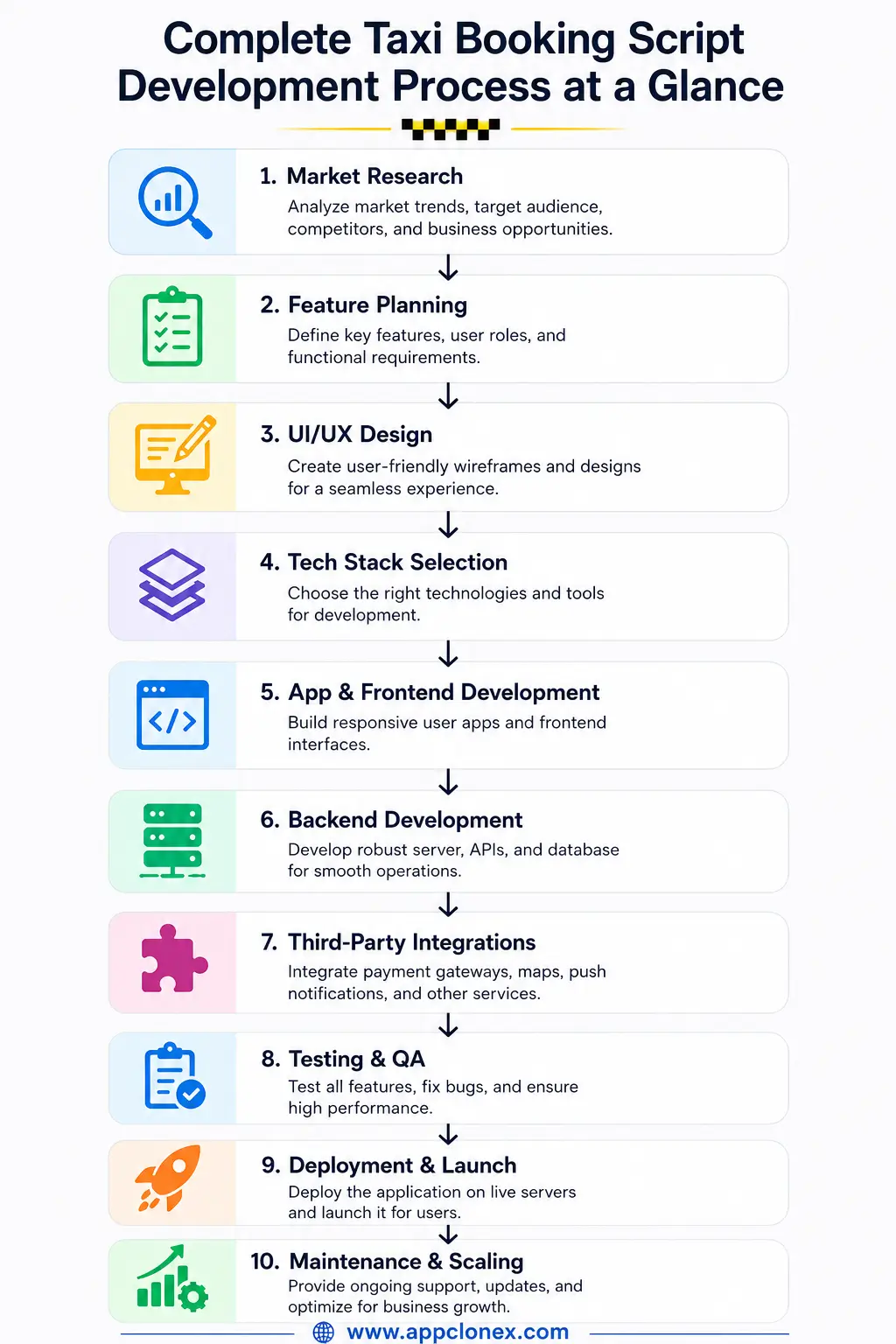
Step-by-Step Taxi Booking Software Development Process
Building a taxi booking software from scratch requires careful planning, the right technology stack, and a structured app development process. Here is a complete guide to developing a ride-hailing platform professionally.
Step 1: Market Research & Business Planning
Before writing a single line of code, understand your market.
Key activities:
- Identify your target audience (local cab users, corporates, tourists)
- Analyze competitors like Uber, Lyft, Ola and their features
- Define your business model (commission-based, subscription, flat fare)
- Choose your target region and understand local transport regulations
- Estimate your budget and timeline for development
A solid business plan prevents costly mistakes during development.
Step 2: Define Features & Requirements
List all the features your taxi dispatch system needs across all panels.
| Panel | Must Have Features |
| Passenger App | Booking, live tracking, fare estimate, payment |
| Driver App | Ride requests, navigation, earnings, availability toggle |
| Admin Panel | User management, pricing, reports, commission |
Core Features to Define:
Advanced Features:
Real-time GPS tracking
Surge / dynamic pricing engine
Multi-payment gateway integration
Promo code & referral system
Scheduled ride booking
Multi-language & multi-currency support
Step 3: UI/UX Design
Design the user interface for all three panels before development begins.
Design Process:
- Create wireframes for every screen and user flow
- Build interactive prototypes for passenger and driver apps
- Design a clean, intuitive UI following platform guidelines (iOS & Android)
- Conduct usability testing with real users
- Finalize design assets, icons, color scheme, and typography
Good UI/UX directly impacts user retention and booking conversion rates.
Step 4: Choose the Right Technology Stack
Selecting the right tech stack for taxi app development is critical for performance and scalability.
| Layer | Technology Options |
| Frontend (Mobile) | React Native, Flutter |
| Frontend (Web Admin) | React.js, Angular |
| Backend | Node.js, Laravel, Python (Django) |
| Database | MySQL, PostgreSQL, MongoDB |
| Real-Time Tracking | Google Maps API, Mapbox |
| Push Notifications | Firebase Cloud Messaging (FCM) |
| Payment Gateway | Stripe, PayPal, Razorpay |
| Cloud Hosting | AWS, Google Cloud, DigitalOcean |
Step 5: Frontend & App Development
Build the passenger app, driver app, and admin dashboard simultaneously.
Passenger App Development:
Registration, login, and profile setup
Location picker with Google Maps integration
Real-time driver tracking on map
Booking flow, fare preview, and payment screen
Ride history and rating system
Driver App Development:
Document upload and profile management
Online/offline toggle and ride request alerts
Turn-by-turn navigation integration
Earnings dashboard and withdrawal request
Trip history and performance stats
Admin Panel Development:
Centralized dashboard with live ride monitoring
Driver and passenger account management
Pricing and commission configuration
Reports, analytics, and revenue tracking
Dispute management and support tools
Step 6: Backend Development
The backend is the engine of your taxi booking platform it powers all logic and data flow.
Backend Development Includes:
- Build RESTful APIs for passenger, driver, and admin communication
- Develop driver matching algorithm (nearest driver logic)
- Set up real-time location tracking with WebSockets or Socket.io
- Implement fare calculation engine (base fare + distance + time + surge)
- Integrate payment gateways for secure transactions
- Set up push notification system for ride alerts
- Build authentication & authorization (OTP, JWT tokens)
- Configure database architecture for users, rides, and payments
Step 7: Third-Party API Integration
Integrate essential third-party services to power your taxi booking script.
- Google Maps API - Route calculation, live tracking, geocoding
- Payment Gateway - Stripe, Razorpay, or PayPal for fare collection
- SMS Gateway - Twilio for OTP verification
- Push Notifications - Firebase for real-time ride alerts
- Email Service - SendGrid for receipts and confirmations
- Cloud Storage - AWS S3 for driver document uploads
Step 8: Testing & Quality Assurance
Thorough testing ensures your taxi booking app is bug-free and reliable.
Types of Testing:
- Unit Testing - Test individual functions and modules
- Integration Testing - Test API connections and data flow
- UI/UX Testing - Ensure smooth interface across all devices
- Performance Testing - Handle high traffic and simultaneous bookings
- Security Testing - Protect user data and payment information
- Real-World Testing - Beta test with actual drivers and passengers
Never skip testing — bugs in a live taxi app damage trust and revenue.
Step 9: Deployment & Launch
Once testing is complete, deploy your platform to production.
Deployment Steps:
- Set up cloud server (AWS, Google Cloud, or DigitalOcean)
- Configure domain, SSL certificate, and security firewalls
- Deploy backend APIs to production server
- Submit passenger and driver apps to Google Play Store & Apple App Store
- Set up database backups and server monitoring tools
- Perform a soft launch with a limited user group before full rollout
Step 10: Post-Launch Maintenance & Scaling
Launching is just the beginning. Ongoing maintenance keeps your platform competitive.
Post-Launch Activities:
- Monitor server performance and fix live bugs
- Collect user feedback and release regular updates
- Add new features based on market demand
- Scale server infrastructure as user base grows
- Run marketing campaigns to acquire drivers and passengers
- Analyze ride data and revenue reports to optimize operations
Estimated Taxi Booking Script Development Timeline
| Phase | Time Estimate |
| Research & Planning | 1 Weeks |
| UI/UX Design | 1 - 2 Weeks |
| Backend Development | 4 - 6 Weeks |
| App Development | 6 - 8 Weeks |
| Testing & QA | 2 Weeks |
| Deployment & Launch | 1 Weeks |
How Much Does a Taxi Booking Script Cost?
The cost of a taxi booking script depends on several factors including the type of solution you choose, the features you need, and the development approach you take. Here is a complete breakdown to help you make an informed decision.
Option 1 - Ready-Made Taxi Booking Script
A taxi booking script is a pre-built solution that you purchase and customize with your brand white label solution.
Cost Range: $2000 to $6,000
Quick setup and deployment
Basic to advanced features included
One-time purchase with optional annual support
Best for startups and small taxi businesses
Option 2 - SaaS-Based Taxi Booking Platform
A cloud-hosted subscription-based taxi booking software where you pay monthly or yearly.
Cost Range: $1000 to $2000 per month
No server setup required
Regular feature updates included
Limited customization options
Best for businesses that want low upfront cost
Option 3 - Custom Taxi Booking Software Development
Building a fully custom ride-hailing platform from scratch with a development team.
Cost Range: $20,000 to $100,000+
Complete control over features and design
Built exactly to your business requirements
Long development timeline of 4 to 6 months
Best for large businesses and funded startups
Which Option Gives the Best Value?
For most taxi business owners and entrepreneurs, a readymade taxi booking script offers the best balance of cost, features, and time to market.
Why Ready-Made Script Wins?
Fraction of the cost of custom development
Proven and tested platform with existing features
Launch your cab booking business within days
Customizable to match your brand and requirements
Technical support included with most packages
No need to hire a full development team
Benefits of Launching a Taxi Booking Business
The on-demand taxi booking industry is expanding at a strong pace worldwide. Launching your own ride-hailing business with a taxi booking script opens up serious opportunities for entrepreneurs and transport businesses looking to build a profitable digital venture.
1. Low Entry Barrier with Ready-Made Solutions
You do not need to build everything from scratch. A white-label taxi booking script allows you to launch your cab booking platform without heavy investment in custom development. Ready-made solutions come with pre-built features like driver management, fare calculation, and live tracking. This means you can go live faster, spend less, and focus more on growing your business.
2. Multiple Revenue Streams
A taxi booking business generates income from several sources at the same time. You can collect a commission on every completed ride, charge surge pricing during peak hours, and offer driver subscription plans for platform access. Corporate contracts, cancellation fees, and in-app promotions add further income on top of your core earnings.
3. High Demand & Growing Market
Passengers today prefer app-based cab booking over traditional street hailing or phone calls. The shift toward digital transport is visible across metro cities as well as smaller towns. Airport transfers, corporate travel, and daily commutes are driving consistent booking volumes on ride-hailing platforms. Tier 2 and Tier 3 cities still represent a largely untapped opportunity for new taxi businesses.
4. Flexible & Expandable Business Model
A taxi booking platform is built to grow alongside your business without major restructuring. You can start operations in one city and expand to new regions by simply onboarding more drivers. New vehicle categories like bikes, autos, and luxury cabs can be added without rebuilding the platform. Cloud infrastructure ensures your system handles increased bookings without performance issues.
5. Automation Reduces Operational Cost
Traditional taxi businesses depend on manual dispatch, phone bookings, and cash handling. A taxi booking software automates the entire process from ride assignment to payment collection. Driver matching, fare calculation, notifications, and invoicing all happen without manual effort. This means you need fewer staff, face lower overhead costs, and can deliver faster service to customers.
6. Data-Driven Business Decisions
Taxi booking script continuously collects real-time data across every ride and transaction. You can identify peak booking hours, high-demand areas, driver performance trends, and passenger retention patterns. This information helps you adjust pricing, improve service quality, and plan targeted promotions. Businesses that act on data consistently outperform those that rely on guesswork.
7. Build a Strong Brand in Your Local Market
Launching your own branded taxi app gives you full control over your customer relationships and pricing. You are not dependent on third-party aggregators who take a larger share of your revenue. Direct engagement with passengers allows you to build loyalty through personalized offers and reliable service. A strong local brand is far more valuable in the long run than being listed on someone else's platform.
8. Secure & Transparent Transactions
Modern taxi booking software comes with integrated payment systems that protect all parties involved. Cashless transactions reduce the risk of disputes, theft, and fare manipulation between drivers and passengers. Automated fare calculation ensures that every passenger is charged correctly and every driver is paid fairly. Secure payment gateways and digital receipts build long-term trust in your platform.
9. Better Experience for Passengers
Passengers today expect speed, convenience, and reliability from any transport service they use. A taxi booking app lets them book a ride in under a minute with real-time driver tracking and ETA updates. Multiple payment options, trip history, and in-app support make the entire experience smooth and hassle-free. A better passenger experience directly leads to higher repeat bookings and stronger word-of-mouth growth.
10. More Earning Opportunities for Drivers
A taxi booking script gives drivers access to a steady stream of ride requests through a simple app. They can manage their own working hours, track daily earnings, and request payouts without any complicated process. Clear commission structures and transparent trip records remove confusion and build driver confidence in the platform. Drivers who trust the platform stay longer and deliver better service to passengers.
11. Supports Multiple Business Models
A taxi booking script is flexible enough to support different types of transport businesses under one platform. You can run a direct B2C cab service, manage B2B corporate transport accounts, or operate as an aggregator connecting independent drivers with passengers. Government transport projects and franchise-based operations can also be handled through the same system. This flexibility makes it a long-term investment rather than a single-use solution.
Why Choose AppcloneX for Your Taxi Booking Script?
AppcloneX is a trusted provider of readymade clone script for businesses across all industries. When it comes to launching a taxi booking platform, delivers a complete, reliable, and fully customizable solution that gets your business live fast.
1. Proven Ready-Made Solution
AppcloneX specializes in delivering ready-made taxi booking scripts that are already built, tested, and market-ready. You do not need to spend months on development or risk your budget on an untested custom build. The platform comes with all essential features pre-loaded and ready to deploy. This gives your cab booking business a professional head start from day one.
2. Fully White-Label & Customizable
Every taxi booking script from AppcloneX is delivered as a fully white-label solution. You get complete freedom to apply your own brand name, logo, color scheme, and app identity. The platform can be customized to match your specific business model and target market. Your passengers and drivers will experience a platform that feels entirely built for your brand.
3. Complete Multi-Panel Delivery
AppcloneX delivers a complete taxi booking system with all three panels fully developed and ready to use.
| Panel | What You Get |
| Passenger App | Android & iOS booking app |
| Driver App | Android & iOS driver management app |
| Admin Panel | Full web-based control dashboard |
4. Cost-Effective Pricing
Compared to building a custom taxi booking software from scratch, AppcloneX offers a significantly more affordable solution without compromising on quality. You get an enterprise-grade taxi dispatch system at a fraction of the custom development cost. The pricing is transparent with no hidden charges or surprise fees. This makes it the smartest investment for startups and growing taxi businesses.
5. Full Source Code Ownership
When you purchase a taxi booking script from AppcloneX, you receive the complete source code with full ownership rights. There are no ongoing licensing fees or dependency on AppcloneX servers to keep your platform running. You have the freedom to modify, extend, and manage the platform entirely on your own terms. Full source code ownership means full control over your business.
Conclusion
The taxi booking industry is one of the most consistent and rewarding segments of the on-demand economy, and the right software is the foundation of any successful operation. From understanding how a taxi booking script works to knowing who can use it, how it is built, and what it costs, every step points to one clear direction the opportunity is real and the tools to capture it are available right now.
Whether you are an entrepreneur launching your first ride-hailing platform, a traditional cab company moving your operations online, or a business owner looking to add transport services to your portfolio, a white-label taxi booking script gives you everything you need to get started without unnecessary delays or overspending.
AppcloneX makes this journey even more straightforward. With a ready-made taxi booking script that is fully customizable, technically sound, and backed by dedicated support, you are not just purchasing software you are investing in a complete business solution. Full source code ownership, multi-panel delivery, and a feature-rich platform mean you are equipped to compete from day one.
Now is the right time to launch your taxi booking business and AppcloneX is the right partner to build it with.


